The difference in one line
A single-breasted jacket has one column of buttons and fronts that only just meet. A double-breasted jacket has fronts that overlap widely, with two parallel columns of buttons.
| Single-breasted | Double-breasted | |
|---|---|---|
| Front overlap | Small, a few centimetres | Wide, often 10 to 15 centimetres |
| Buttons | One column: one, two or three buttons | Two columns: usually six, with two or three that fasten |
| Lapels | Notch, peak or shawl | Almost always peak |
| Worn open? | Yes, often | No, designed to be worn fastened |
| Vents | Centre or side vents | Side vents or none |
| Formality | From casual to formal | Formal to very formal |
| Feel | Versatile, easy, modern | Structured, confident, a little old-world |
What is a single-breasted jacket?
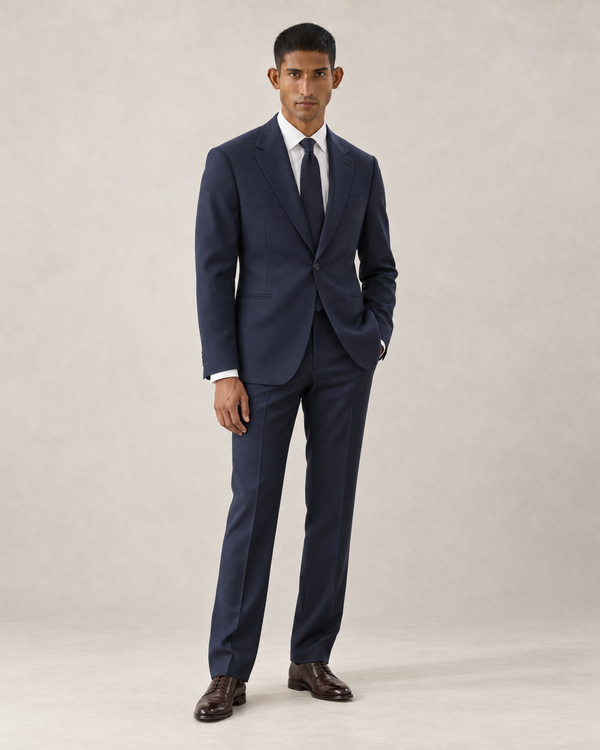
It is the standard jacket: the one most people picture when they think of a suit. The two front edges meet at the centre with a small overlap and fasten with a single column of buttons. Two buttons is the modern default; one button is common on dinner jackets; three is rarer and more traditional. It can be worn open or closed, over a shirt and tie or a T-shirt, which is why it is the more versatile choice. The Lutyens is a two-button single-breasted suit.
What is a double-breasted jacket?
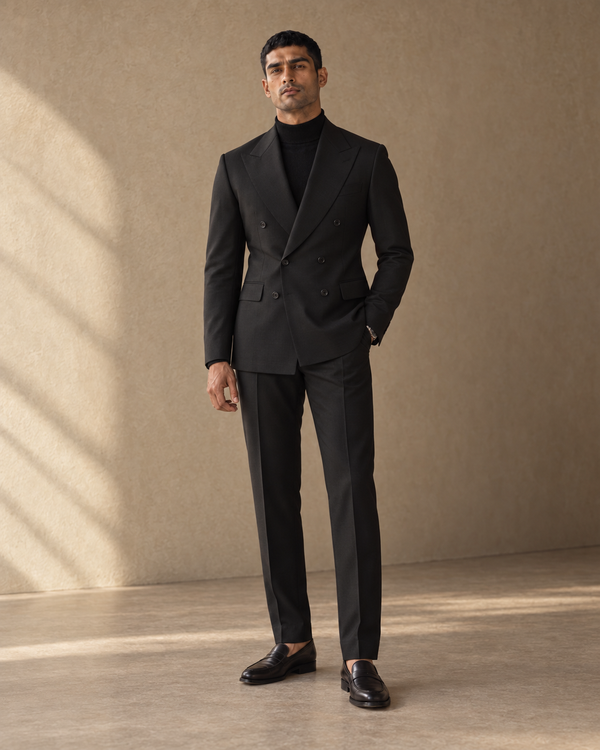
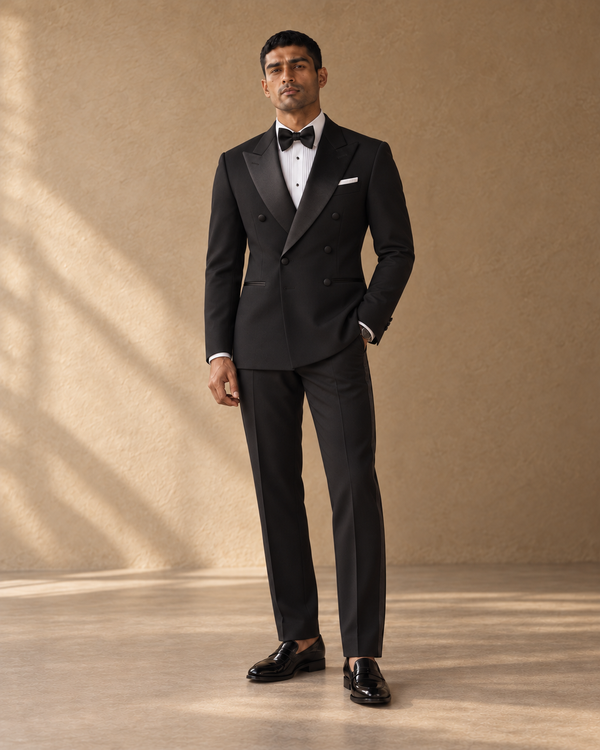
The left front crosses well over the right and fastens on the far side, leaving two columns of buttons. The most common layout is six buttons with two fastening, written as "6x2". It has peak lapels, a stronger chest and a sharper line. It is designed to be worn buttoned, which gives a clean, unbroken shape from shoulder to hip. The Regent is a 6x2 double-breasted suit; the Nocturne is a double-breasted tuxedo.
How to button each
- One-button single-breasted: fasten it standing, open it to sit.
- Two-button single-breasted: the top button only. Never the bottom.
- Three-button single-breasted: the middle button; the top one is optional.
- Double-breasted 6x2: the fastening button, and the inner (jigger) button on the other side. Some men leave the lower of the pair open.
Which suits your build?
- Tall and slim: both work. Double-breasted adds width and presence.
- Broad or heavier: a well-cut double-breasted can look very good, because it forms a single strong column; a lower button stance helps. Single-breasted is easier.
- Shorter: single-breasted with two buttons is the simplest. A double-breasted can work with a higher button point and a shorter jacket.
Cut matters more than the rule. A double-breasted jacket that is too loose, too long or too wide in the lapel looks like the 1980s; one cut to your measurements looks current.
When to wear each
- Single-breasted: every day, the office, interviews, weddings, and as a separate with trousers or jeans.
- Double-breasted: boardrooms, formal evenings, receptions, black tie and anywhere you want to look deliberate.
For evening wear, see how to choose a tuxedo. For every other term you might meet at a fitting, see the menswear glossary.
Questions, answered
A jacket with one column of buttons and only a small overlap where the fronts meet. Most suit jackets are single-breasted, usually with two buttons.
A jacket whose fronts overlap widely, with two parallel columns of buttons. The usual arrangement is six buttons, two of which fasten.
It is designed to be worn fastened. Open, the wide fronts flap. Unbutton it when you sit if you need to, and fasten it again when you stand.
On a two-button jacket, the top one only. On a three-button, the middle, and sometimes the top. Never the bottom button.
It can be, cut with a higher button stance, longer lapels and a slightly shorter jacket. Many shorter men find a single-breasted jacket easier.